Six In-Demand Jobs and How to Get Them

Print Article

Posted Jul 13th 2009 3:00PM

by Craig Howie, for AOL Find a Job

policeAlongside death and taxes, it seems inevitable there will be crime, war and students. To the upside, there also always will be big business and the multiple web technologies it helps foment in startups across the nation. So in recessionary times, does it make sense to pursue a career in a so-called "bulletproof" field? And if so, what are the best degrees to help you land a job at a major corporation, as a teacher, or in criminal justice or the military? And why is the often challenging, but ultimately fulfilling, process of studying for a degree so valued in the workplace? We take a look.


1. Military

Len Cutler, formerly a military public affairs specialist who served a term in Afghanistan before a battlefield injury cut short his career, says a college degree gives any recruit a great head start in climbing up the military ranks.

"College credits, whether you have a degree or not, improve your starting rank. With a bachelor's degree, you may enter the military as an E-4, with a substantially higher pay rate - although military pay is still relatively low compared to many civilian jobs. If you don't have a degree, your credits are still good for a higher starting rank, up to E-3.

"E-4 is the highest rank you can achieve without specific military training, so jumping to the end of the line is a big help."

Cutler, who completed a two-year associate degree in Alaska and entered at E-3, recommends that college grads enter the military as an officer. Financially, he says, this is a much more attractive option since officers receive substantially higher pay than their enlisted counterparts. He says electronics and engineering skills are always in demand alongside foreign language specialists, particularly in Korean and Arabic.

"Believe it or not, musicians are usually in short supply, too. The Army Band, for example, is on the critical shortage list more often than not."

He says that in many cases recruits will end up placed where the army's need is most -- but you don't have to accept anything you don't want.

He recommends recruits at the enlistment center clearly and forthrightly state their choice of position. Cutler often worked as a journalist in the combat theater getting despatches and sending photographs from the front line, which subsequently helped him land a career in the media.


2. Business

Shannon Small, an MBA coach and senior consultant with nextsteppartners.com who has prepped thousands of MBA students and graduates across the world for six years, says she shares many of the benefits of her Yale School of Management MBA with her students, including "exposure" and "an expansive network."

"In this economy, one of the greatest benefits of an MBA is the broad exposure. Companies that are trying to do more with less are more willing to put them to work knowing they have capabilities in business fields. With an expanisve network they can tap into the greater reach of the alumni networks."

She says many of her students have gone onto jobs in "green tech and clean tech," two popular fields in the enviromentally conscious Bay Area, alongside financial services firms and computer and internet startups. Mostly she teaches students from Stanford and Harvard, and mentors over the phone and online to students in the UK, Turkey and Pakistan.

Students are more concerned about their employment prospects than before, Small says, and some are taking an MBA as a "hedging strategy," against unemployment. She says her MBA changed "all aspects of her life" -- including how she read the newspaper -- by better understanding industry trends and global affairs. Small leads group workshops where jobseekers go to gain "their next step in life. It's a great way to know they're not alone. A job search can be very lonely."


3. Teacher

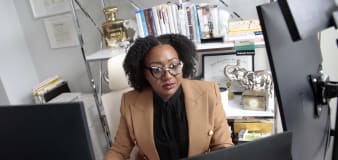
High-school writing teacher Sean Giaffoglione says his choice of an English major allowed him to teach English, Writing or Journalism at his Southern California high school.

He had no choice though, he says, than to attend college for an additional two years in order to complete his bachelor's degree after obtaining a two-year associate's degree. "Had I not had the degree, I would never have gotten the job." While a bachelor's degree is a pre-requisite of teaching in most school districts, including Giaffoglione's, he says instructors usually will be required to teach in a field related to their degree, that a science major likely will be limited to teaching biology or chemistry, for example. In many states, a teaching certificate is also required. He says that as long as there are students, there will always be a need for teachers, and schools in his area were recruiting actively until recently.

He says his time at San Diego State University and his relatively recent jump into teaching two years ago helped him "connect with students," but says he especially uses the literary analysis and theory that he learned for his final thesis.
"There are a lot of important personal reflections there, and of course all the grammar."


4. Police officer

Want to be a police officer but don't want to study a degree related to criminal justice? Officer Karen Rayner of the Los Angeles Police Department says the LAPD doesn't specify a candidate needs a degree in the field. "Certainly it's welcome, but we welcome any degree. We have people who have degrees in theology, science, doctors and lawyers. Primarily [a degree in criminal justice] may help a person have an understanding of the type of work we do but we don't look exclusively for people with one."
She says that candidates for promotion to the rank of sergeant must have 60 credits of degree-level instruction or an equivalent qualification, and says the LAPD offers training courses for its officers to help them qualify.

Officer Rayner says her bachelor's degree in organizational management helped her adjust to working in an institution the size of the LAPD, which Rayner compared to "a corporation," and which has sworn in about 10,000 officers for its most recent graduating class and is actively recruiting on a starting salary of $56,500.

Raymer adds" The only requirement in terms of becoming an officer is you have to have a high-school diploma but lots of people here have criminal justice degrees. Education is a great thing and it's always to be encouraged."


5. Optician

Tom Barracato, the president of Adolph Optical Services in Akron, Ohio, says a mix of a degree and practical experience helps boost a prospective optician's career prospects in a field where there's always a demand for care.

He says different states have separate guidelines on education requirements, but his office requires a previous apprenticeship, degree and state license exam. Any qualification in the sciences field usually over four years or more is useful, he says, adding that there's "a lot of reward" in working at his medium-sized independent firm. "One thing that's enjoyable is we provide vision for people. We're dealing with children who put on their eyeware for the first time in their lives and get a good, clear look at mom and dad and that's very exhilirating."

Barracato, who's been an optitician since graduated locally in the early 1980s, adds: "On a sales level, it's fun, too. We get out some nifty tools and tinker for a bit. I enjoy it very much, I don't look at the clock."


6. Web designer/developer

Joe Dickson, a college web site developer, says his graphic-design degree taught him the most valuable thing he needs to compete in today's rapidly changing technology market: lifelong learning.

"Everyone's doing things differently with new technologies such as social networking. As a web designer I have to implement these technologies in one way or another, usually by picking up a book and learning as I go."

Dickson, who works with the promotional team at Pitzer College in Claremont, Calif., says his job sometimes falls outside the realm of IT depending on the company, like at Claremont, and he learns techniques to accommodate whichever company employs him, though he also is comfortable dealing with "back-end" tech issues like servers and mainframe computers.

Right now, he's working on a complete redesign of the college's web site, projected to launch in June, and online presentation of the school's Commencement ceremonies. "It's exciting being able to build something from the ground up, with a complete understanding of entire projects from begining to end.

"I'm a visual designer, but when I graduated from Cal Poly Pomona in 2001, there weren't any magazine or layout jobs. So I focused on web design."


It's never too late to increase your opportunities
Learn more at University of Phoenix


Next: Mystery Shoppers Go Back to School >>

Reader Comments (Page 1 of 36)
Add your comments

First time? A confirmation email will be sent to you after submitting.


Please keep your comments relevant to this blog entry. Email addresses are never displayed, but they are required to confirm your comments.

When you enter your name and email address, you'll be sent a link to confirm your comment, and a password. To leave another comment, just use that password.

To create a live link, simply type the URL (including http://) or email address and we will make it a live link for you. You can put up to 3 URLs in your comments. Line breaks and paragraphs are automatically converted — no need to use <p> or <br /> tags.

ADVERTISEMENT

Find a Job

Search by Company
Search by Industry


Job Search Tools & Resources

Menu Down